Luxury Hardwood Flooring: What Every Homeowner Should Know
Hardwood flooring has been used in exceptional homes for centuries, and there is a simple reason for its longevity: few materials can match the warmth, character, and authenticity of real wood.
But not all hardwood flooring is created equal.
The species of timber, quality of the wood, construction, grading, dimensions, finishing techniques, and installation all influence how a floor will look and perform over time.
At Chateau Napoleon, we approach luxury hardwood flooring as an architectural material rather than simply a surface covering. Our French Oak and Black Walnut collections are created for homes and interiors where the floor is intended to become an important part of the design.
This guide covers some of the most important things to understand before selecting a hardwood floor.
What Is Luxury Hardwood Flooring?
Luxury hardwood flooring begins with exceptional natural timber, but the wood itself is only the beginning.
A truly exceptional floor considers:
Wood species and provenance
Quality and grading of the timber
Grain and natural variation
Plank width and length
Construction
Surface texture
Finishing process
Color development
Installation
The architecture surrounding it
The difference becomes apparent when the floor is installed across an entire room.
Instead of looking repetitive or manufactured, beautifully crafted natural hardwood develops movement. Individual planks interact with one another, creating subtle variations in grain and tone that give the floor depth.
This individuality is one of the qualities we value most in real wood.
French Oak Flooring
French Oak has long been associated with fine European interiors.
It offers a beautiful balance of strength, distinctive grain, natural character, and versatility. Depending on how it is selected and finished, French Oak can complement contemporary architecture just as beautifully as a traditional residence.
Its natural characteristics also make it particularly responsive to sophisticated finishing techniques.
At Chateau Napoleon, our French Oak collections range from pale, understated finishes to natural warm tones, smoky greys, deep browns, and dramatically aged appearances.
The goal is never simply to make the wood a particular color.
It is to allow the character of the Oak to remain visible beneath that color.
Black Walnut Flooring
Black Walnut has a completely different personality.
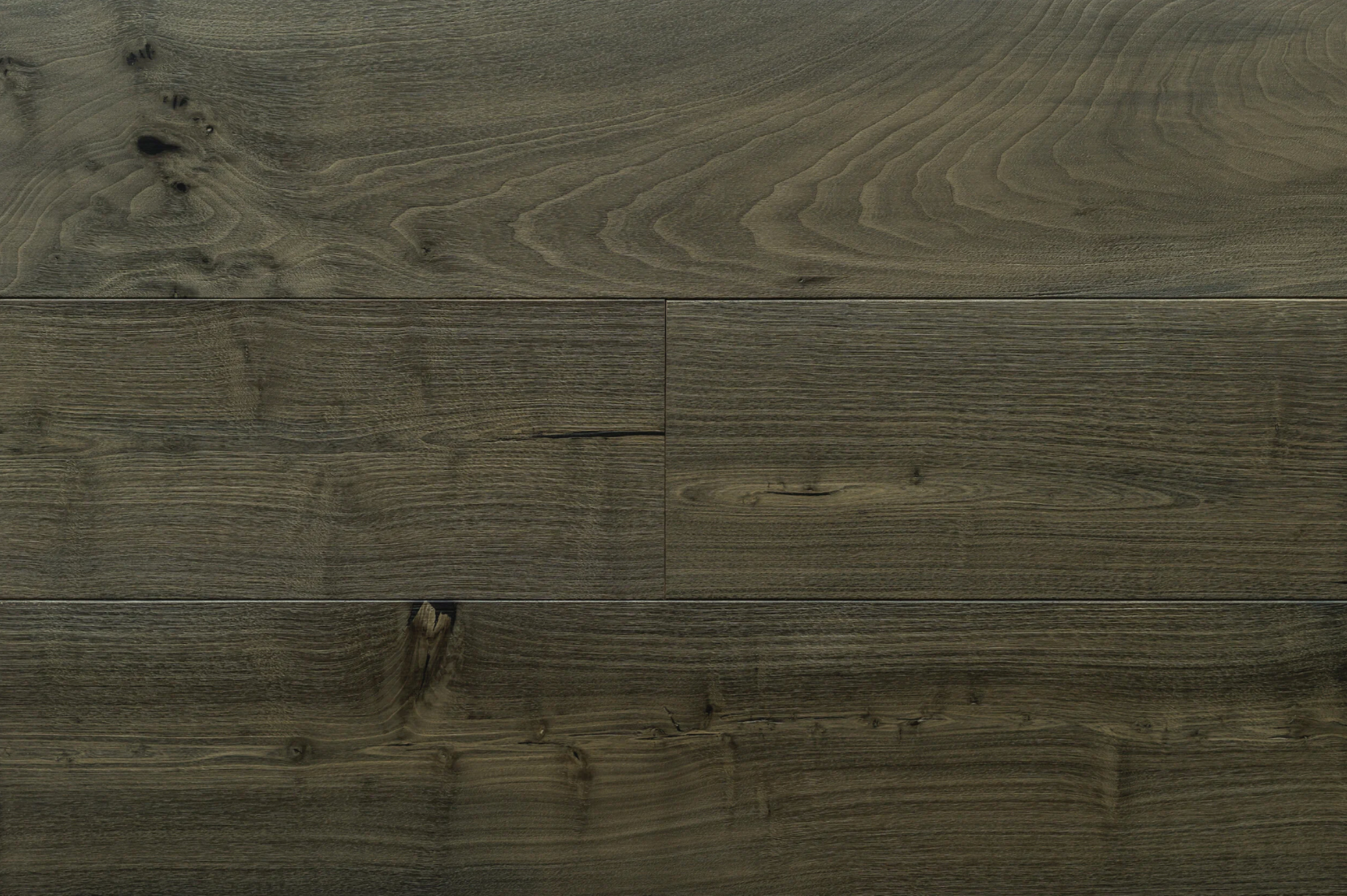
Its flowing grain and naturally rich coloration create warmth and movement that are immediately recognizable.
American Black Walnut has also become particularly important to Chateau Napoleon because of the extraordinary way it reacts to our French oxidation techniques.
Rather than simply applying a dark stain, oxidation interacts with the natural tannins and characteristics of the timber. This allows us to create remarkable variations in color while preserving the grain and individuality of the Walnut.
The result can range from soft natural tones to sophisticated greys, warm browns, pale finishes, and considerably darker expressions.
For clients looking for a floor with tremendous character, Black Walnut can be extraordinary.
French Oak vs. Black Walnut
Neither species is inherently better.
They simply create different interiors.
French Oak generally offers a stronger, more structured grain and tremendous versatility. It can move easily between contemporary, rustic, traditional, and transitional architecture.
Black Walnut tends to feel richer and more expressive, with flowing grain patterns and natural tonal movement.
There is also a difference in hardness. American Black Walnut has a Janka hardness rating of approximately 1,010, while American White Oak is approximately 1,360.
But hardness alone should never determine whether a wood species is appropriate for a luxury residence.
Construction, finish, installation, maintenance, traffic, and the way a home is actually lived in are equally important considerations.
We have supplied hundreds of thousands of square feet of Black Walnut flooring over the years, and it remains one of the materials that best represents what Chateau Napoleon can create through French oxidation.
Understanding the Janka Hardness Rating
The Janka scale measures a wood species' resistance to indentation.
A higher number generally indicates a harder wood.
It is a useful reference when comparing species, but it should not be treated as a complete measurement of flooring quality.
A floor's real-world performance also depends on its construction, finish, maintenance, environmental conditions, and installation.
A harder species does not automatically make a more beautiful—or more appropriate—floor.
For us, selecting hardwood is always a balance between performance and character.
Solid vs. Engineered Hardwood Flooring
One of the most common questions when specifying hardwood flooring is whether to use solid or engineered construction.
Solid Hardwood
Solid hardwood is milled from a single piece of timber.
It has been used traditionally for generations and offers the advantage of substantial real wood throughout the plank.
However, because wood naturally expands and contracts as environmental conditions change, solid hardwood requires careful consideration of climate, subfloor, plank dimensions, and installation.
Engineered Hardwood
Engineered hardwood uses a genuine hardwood wear layer over a carefully constructed core.
A properly manufactured engineered plank can offer greater dimensional stability, particularly for wider flooring and installations over concrete or in environments where seasonal humidity changes need to be considered.
The important word is properly.
Engineered hardwood ranges enormously in quality. The thickness and quality of the wear layer, core construction, adhesives, milling, and finishing all matter.
For a luxury project, these details should be understood before the flooring is specified.
Why Wide Plank Hardwood Flooring?
Plank dimensions dramatically affect how a floor looks.
Traditional narrow flooring creates considerably more seams and visual lines across a room.
Wide plank hardwood flooring does the opposite.
With fewer interruptions, more of each individual board becomes visible, allowing the grain and natural movement of the timber to become part of the architecture.
This can be particularly beautiful in large residences and open-plan spaces.
But plank width should always be considered alongside room proportions, timber stability, construction, and installation conditions.
The objective is not simply to use the widest board available.
The objective is proportion.
Grade and Natural Character
Wood is not manufactured.
It grew.
Knots, mineral streaks, grain movement, tonal variation, and other natural characteristics tell part of that story.
Different grades determine how much of this natural character appears in the finished flooring.
Cleaner grades create a quieter and more uniform appearance.
Rustic grades allow considerably more variation and can create floors with tremendous personality.
Neither should automatically be considered superior.
A beautifully designed rustic floor can look extraordinary in the right architecture, while another project may call for something much cleaner and more restrained.
The grade should serve the design.
Why Finish Matters
The finishing process can completely transform hardwood.
Conventional staining primarily introduces pigment to create a desired surface color.
Our approach is different.
Chateau Napoleon is particularly known for French oxidation, a process that works with the natural characteristics of the timber to develop color from within the wood itself.
Because every plank contains natural variations, each piece can respond slightly differently.
That is intentional.
Rather than trying to make natural wood perfectly uniform, we celebrate the variations that make it real.
Étains La Flamme
Another part of our process is Étains La Flamme, our flame treatment used in creating selected Chateau Napoleon finishes.
Carefully controlled flaming influences the character and appearance of the timber before subsequent finishing processes are completed.
Combined with oxidation and traditional European finishing techniques, it contributes to the depth and individuality found throughout our collections.
These processes are not designed to disguise the wood.
They are designed to reveal it.
Choosing the Right Color
Floor color should never be selected independently from the rest of the room.
Consider the relationship between your floor and:
Natural light
Cabinetry
Stone
Wall finishes
Furniture
Metal finishes
Rugs and textiles
Light hardwood flooring can create an open, relaxed feeling.
Natural and medium tones introduce warmth while remaining versatile.
Dark flooring can create extraordinary contrast and drama, particularly in large spaces with generous natural light.
But photographs can only tell part of the story.
Natural wood should be seen in the environment where it will eventually live.
Installation Matters
Even extraordinary hardwood can perform poorly if it is improperly installed.
Before installation begins, your installer should understand the flooring construction, subfloor, environmental conditions, moisture levels, heating system, required expansion allowances, and recommended installation method.
Depending on the flooring and project, installation may involve nail-down, glue-down, or another professionally specified method.
Subfloor preparation is equally important.
The surface should be structurally sound, appropriately level, clean, and within acceptable moisture conditions before flooring is installed.
For significant luxury residential projects, professional installation by someone experienced with high-quality hardwood flooring is strongly recommended.
Acclimation and the Environment
Wood naturally responds to its environment.
Temperature and humidity influence the amount of moisture contained within timber, which can cause it to expand or contract.
For that reason, flooring should be handled, stored, acclimated when required, and installed according to the specifications appropriate for the product and project environment.
Environmental control after installation is equally important.
A luxury hardwood floor should be treated as part of the home—not as an indestructible manufactured surface.
Caring for Luxury Hardwood Flooring
Good hardwood flooring does not require complicated maintenance.
Regularly remove dust and grit that could scratch the surface.
Use cleaning products appropriate for the specific finish.
Avoid allowing standing water to remain on the floor.
Use protective pads beneath furniture.
And understand that natural wood will gradually develop character as the home is lived in.
A floor does not need to remain completely untouched to remain beautiful.
In many of the finest interiors, the way natural materials age is part of their appeal.
Is Hardwood Flooring a Good Investment?
A beautifully made hardwood floor can remain part of a home for decades.
Unlike many synthetic flooring products designed to reproduce the appearance of timber, genuine hardwood offers natural grain, texture, tonal variation, and the possibility—depending on its construction and wear layer—of restoration or refinishing.
But for a luxury home, we believe its greatest value is simpler.
It is real.
Natural wood has a presence that is extremely difficult to reproduce artificially.
How Should You Choose Luxury Hardwood Flooring?
Start with the architecture rather than the flooring catalog.
Ask yourself:
What should this home feel like?
Warm?
Light?
Understated?
Rustic?
Contemporary?
Dramatic?
Once that has been established, species, grade, plank dimensions, texture, and color can be selected to support that vision.
The best floor should not compete with the architecture.
It should make the architecture better.
Frequently Asked Questions
Is French Oak good for luxury hardwood flooring?
Yes. French Oak offers distinctive natural grain, versatility, durability, and exceptional finishing possibilities, making it particularly well suited to sophisticated residential interiors.
Is Black Walnut too soft for hardwood flooring?
Black Walnut is softer than Oak according to the Janka hardness scale, but hardness is only one factor in flooring performance. Proper construction, finishing, installation, maintenance, and intended use should all be considered. Chateau Napoleon has supplied hundreds of thousands of square feet of Black Walnut flooring for residential projects.
What is wide plank hardwood flooring?
Wide plank flooring uses boards considerably wider than traditional strip flooring. Wider boards create fewer seams and allow more of the timber's natural grain and character to be visible.
What is French oxidized hardwood flooring?
French oxidation uses chemical reactions with naturally occurring characteristics within the timber to develop color and depth rather than relying exclusively on conventional surface stains.
Is engineered hardwood real wood?
Yes. Quality engineered hardwood has a genuine hardwood surface bonded to a structural core. Construction quality and wear-layer thickness vary significantly between manufacturers.
Should I see a hardwood flooring sample before ordering?
Absolutely.
Natural wood varies, and photographs or computer screens cannot perfectly reproduce its color, grain, texture, or interaction with light.
We strongly recommend viewing physical samples alongside the other materials being considered for your project.
Experience Chateau Napoleon
For us, hardwood flooring has never been simply about covering a floor.
It is about creating something that becomes part of the architecture.
Chateau Napoleon combines exceptional French Oak and Black Walnut with European craftsmanship, French oxidation, flame treatments, and distinctive finishing techniques to create luxury hardwood flooring with remarkable depth and character.
Every project is different.
And every piece of natural timber is different.
We wouldn't want it any other way.
Request a complimentary hand-cut sample and experience Chateau Napoleon's French Oak and Black Walnut collections in your own space.